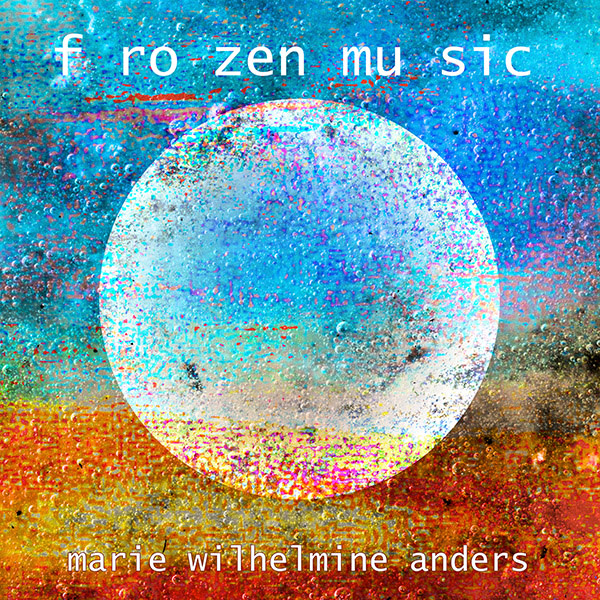
Marie Wilhelmine Anders’ new, multi-genre concept album “Frozen Music” follows up on her albums “Travels” (Broque) and “She’s Leaving” (Noisy Meditation). Being her fifth album, which refers to the poetry of Robert Louis Stevenson, “Frozen Music” also evolves around another main source of inspiration that is drum ’n’ bass: Sunchase (who mastered „Frozen Music“ superbly), dBridge, Calibre, Krust, Goldie (Mother!), Optical, T.Power, LTJ Bukem, Banaczech, are just a few of her main influences.
While searching for the connecting elements between the poem template from the late 19th century and the time when d’n’b was created 100 years later, she found the sound of the foghorn, invented in the year Stevenson was born. The foghorn was first installed in Jamaican sound systems in the 1950s, and it created an unexpected power in the bass range, and from there found its way into the raves and d’n’b productions of the children of the “Windrush” generation in the UK.
The second connecting element Marie found was the music of Claude Debussy: his “liquid works” (David Toop) – influenced by the music of Java, Cambodia, Vietnam, and Japan – in turn influenced the later generation of ambient music producers. The chord progressions from his “Prelude” from “Pour Le Piano” reappear in a stretched and filtered form in Marie’s ambient intro track “Prelude” and in a few other places in “Frozen Music“.
The nine tracks of “Frozen Music” find their very own form in the atmospheric recreation of the pictorial language of Stevenson’s poem “Evensong” and in its relationship to some of the most fascinating genres in electronic music. Being a classically trained composer Marie juxtaposes ambient, breaks, d’n’b, and techno. She approaches the boundaries of genres with a kind of innocence, always listening to the connections between the different styles. In “Frozen Music” she picks up on these connections. This works so well because the musical forms often don’t adhere to what you would deem traditional structure. Dynamic quality, form, sound design and, last but not least, the mix of her music are all the more carefully coordinated and result in a catchy flow that makes „Frozen Music“ another masterpiece, that not only brings food for thought but, most importantly, transports the grooving d’n’b sound of the 90’s onto the contemporary stage.
How to listen: There are a couple of ways to proceed. First, you can listen to the whole album, which you will find below, and then read the notes. Or, read the notes as you listen to each track. This will completely change your perspective on the whole release itself and bring you closer to the artist and their work.
1) Prelude
The intro track for “Frozen Music” is the connecting piece to my previous albums “She’s Leaving” (a pure ambient album, released by Noisy Meditation) and “Travels” (released by Broque). “Frozen Music“, like others of my albums before it, references poems by Scottish poet Robert Louis Stevenson (1850-1894). “Prelude” picks up where “Travels” left off: with the sound of an airplane taking off, which I had recorded at my home, living near Berlin’s Tegel Airport. Before the ambient track introducing the album was named „Prelude”, it was called “The Great Sky”, after the verse line “the great sky darkens overhead, and the great woods are shrill” from the poem “Evensong”, which is one of the pillars of my album “Frozen Music”. But ‚great‘ always made me think of a certain former US president, so I changed it. “Prelude” also fits better as a title because I borrowed the chord progression from the piano piece “Prelude” from “Pour Le Piano” by Claude Debussy. Claude Debussy was born in 1862, 12 years later than Stevenson, and can be considered his contemporary. The two could well have met on their travels through France, although this has not been handed down. It is said that Debussy was inspired for “Prelude” by the Javanese music shown at the Paris „Exposition Universelle” in 1889 (at the same exposition, among others, 400 inhabitants from the French colonies were “exhibited” in a so-called “village nègre”, a “human zoo”, as well as Edison’s phonograph).
Debussy’s harmonies no longer follow the tonality principle but develop an impressionistic tonal language in the direction of serialism. Electronic music also does best without tonic and dominant, and likes to move chords, if at all. David Toop writes in “Oceans Of Sound” that Debussy starts to compose his ‚iquid works‘ after the exhibition: “La Mer”, “Reflets dans l’eau”, ” Jardins sous la pluie”, “Poissons d’Or”; or just the “Prelude” from “Pour Le Piano”; and that Debussy’s music, in turn, influenced many ambient music producers at the end of the 20th century. Later I learned that the South Seas, or Pacific Ocean, where the poem was written on the island of Upolu, part of Samoa, is called Great Ocean in the language of the First Nations – i.e. the people who lived there before and after colonization – which in turn makes me think of the verse line “the great sky darkens overhead, and the great woods are shrill“.
2) Embers
The track picks up the dark red mood of “Prelude”, adds some blue, and gets things moving at 130 bpm. Sonically restrained, it functions as a hinge between “Prelude” and the following tracks, whose mix gets brighter and brighter all the way to “Spread.” The sound and title reference the first two lines of verse from the aforementioned poem, “The embers of the day are red beyond the murky hill.”
3) The Kitchen And The Bed
One of my personal favorite tracks on the album. Here my love for Drum & Bass and especially for Minimal D’n’B is shining through. I’m thinking first of all of Sunchase (who did a great mastering job on “Frozen Music”), and especially of his album “Timeline”. If you listen to “Step Outside” there, you might hear that I was inspired by his sound. My vocals come from a track from one of my previous albums, “Andersworld”, so it makes a reference to that. The title of the track quotes the figurative verse line “The kitchen smokes: the bed in the darkling house is spread”, which I found incredibly inspiring. The colors are dark brown and spark yellow. Not quite as muted as “Embers,” but still a smoky sound. Plus a stoic hi-hat that pushes the envelope with being into the foreground and takes the lead role again and again. That’s what I like to do: put the musical elements that have always had their fixed role in an arrangement in a different position in the mix.
4) Clap
A first energetic highlight of the album. This track is very inspired by drum & bass producer and Noisy Meditation label mate 88 Katanas. I spent a hot summer driving around with his two tracks “Echo Sliding” and “Real Thugs Recycle” in my ears and got more and more into it. The groove of “Echo Sliding” has an incredibly agile spring to it, metallic and alive. I tried to bring that elastic vibe into „Clap”. When everything was finished, something was missing: so again I got some vocals chops from my album “Andersworld”, from the intro track “Keepsake Mill”. I didn’t had to time-stretch anything, it just fit that way.
I hope that the tension that arises from the fast, metallic and somewhat hard sounds of “Clap” and the vocals, where the “marvellous place” is mentioned, can somewhat reflect the tension that is fed by the historical and geographical references, which I have rudimentarily described for „Prelude”. When I produced “Frozen Music”, I was not yet aware that Samoa, the island where the Scottish author Stevenson spent the last years of his life and where he wrote the poem “Evensong”, was to become a colony of the German Empire shortly afterwards. I hope that with “Clap” a dismanteling the supposed South Sea idyll, the ‘place in the sun’ that the Germans claimed for themselves, is perceptible.
5) Breeze
As throughout the album, the title again refers to the poem “Evensong”, here: “The breeze from the embalmed land blows suddenly towards the shore”. A short interlude. Actually just a loop. It should not be beautiful. But loud. Noisy. Impenetrable. The short ambient track ends the first part of the album and introduces to the second part. I recorded the macaws a few years ago with my OKM-2 at the zoo, the Tierpark Berlin. Also some other field recordings I made in that time are used here. A musically whistling grey parrot in the background. Voices of adults and children.
6) Signal
Again my shots of the Military macaws and some ambience as before in “Breeze”. – By chance, a book on the cultural history of the foghorn, „The Foghorn’s Lament: The Disappearing Music Of The Coast“ by Jennifer Lucy Allan, fell into my hands when I was actually looking for literature on Samoa. Until then it was not clear to me how I could combine my idea, music about Stevenson living in the 19th century on the one hand and approaching the history of Drum & Bass on the other hand. “I hear the signal, Lord”: this verse line opened a wide associative space for me. Stevenson will not have meant it with his words, but here the music links for a short moment to the foghorn, the maritime signal horn, which was first invented in 1850, the year of Stevenson’s birth, by a Scottish engineer stranded in Canada, Robert Foulis, (by the way, Stevenson comes from a famous Scottish family of lighthouse engineers and, if it had been up to his father, should have pursued this career as well) and which, a hundred years later, found its way into Jamaican sound systems and from there into the raves and Drum & Bass productions of the children of the ‚Windrush Generation‘ in Great Britain.
If you listen closely, you will find my little foghorn, which I made myself in Massive. The overlong break in the track, which again falls back on chord progressions from Debussy’s “Prelude”, refers less to the dancefloor than to the music connoisseur listening alone with ears prick up and perhaps also to my own listening past, when I discovered the overlong and formally experimental pieces of progressive rock music for myself as a teenager. The heaviest track on the album. Very inspired by Krust’s brilliant album “The Edge Of Everything“.
7) Spread
140 bpm: I find this a very exciting tempo. Calibre dedicated an entire album to this tempo range with “Feeling Normal”. There are also some enchanting tracks in this tempo on “Double Bend”. And even more than his Drum & bass productions I am intrigued by these. His grooves in “Say Enough“ or “Rare Groove” were the inspiration here. The title again refers to the aforementioned verse line which I used also for “The Kitchen And The Bed”.
8) So Far
I guess this track falls pretty much out of the frame that “Frozen Music” has staked out so far, but had to have its place here. Again, 140 bpm, which brings it close to “Spread”, but techno. Why did it have to go in here? It just sounds like frozen music to my ears. I put in the snare rhythm of the ‚Amen Break‘, which, everybody knows, is shaping the genre of Drum & Bass – here in an quite different environment, I admit it. The spoken numbers are the sample numbers from a series of Paradox’s Wax Breaks. Ableton had made some of them available for free download as part of a highly recommended feature with the D’n’B producer. I didn’t use the loops themselves anywhere in the album. I will do this in another place.
9) Evensong
One of my personal favorite tracks. At 155 bpm, it bows deeply to LTJ Bukem’s “Music,” a track that casts a strange spell on me every time. Also, “Evensong” is influenced by the Drum & Bass producer duo Banachez (I thank Godfather Sage for pointing them out). Here the album opens in an epilogue that leaves the frozen landscapes and, unlike before, sings goodbye with its own chord progressions. As such, can also be heard as a segue to the next, my upcoming album.
Grab your copy here.