
Roland recently debuted a new line of keyboard workstations called the FANTOM-0 series. This new line of keyboards stems from Roland’s flagship FANTOM line from previous generations.
Check Out Our Full Coverage Of The FANTOM-0 Series Launch
The new iterations seen by the FANTOM-0 series offer new features, more robust functionality, and an intuitive workflow that makes this keyboard ideal for gigging musicians and studio-working producers.
We had a chance to get our hands on the smaller FANTOM model, the FANTOM-06, to dive deep into everything this powerhouse keyboard offers. If you are on the fence about whether this unit suits you and your studio, this guide will answer every question you might have (…and likely a few more you haven’t thought to ask yet).
Learn more about this keyboard and help support our team through our partnership with Sweetwater by clicking here.
Unboxing The Roland FANTOM-06 61-Key Synth Workstation

The FANTOM-06 offers a lot to process straight from the box. Its bells, whistles, parameters, knobs, and faders are visually inspiring, but the real question is their practicality when you’re eager to start making music.
However, that evaluation had to be postponed because it was necessary to apply an update before I could connect the Roland keyboard to my computer effectively. Loading the update onto a USB, installing it on the keyboard, and using it via the onboard touchscreen was somewhat cumbersome — a feeling likely amplified by my eagerness to explore the FANTOM-06’s sounds and features.
The keyboard’s build quality is exceptional, clearly reflecting Roland’s intention to craft a synth workstation for musicians who perform live. Each pot, dial, and fader is robust to the touch, and the pitch and modulation wheels operate smoothly, even under aggressive use.
The FANTOM nestles comfortably into my small-to-medium-sized studio space. Despite its substantial 61-key layout, it integrates well into my area, routine, and workflow. After just a few hours of exploration, it was evident that this instrument performs its functions admirably.
My only criticism of this music workstation keyboard is the absence of weighted keys. If the Roland Fantom-0 series featured weighted keys with responsive touch and expression, it would genuinely distinguish itself in a market flooded with electronic and acoustic keyboards.
Snag Premium House Music Samples Without Breaking The Bank With Our Massive Curated List Of Warm, Punchy Sounds From Across The Internet. Click Here To Get 4k+ Free Sounds and Samples
What Is The Roland Fantom-0 Series?
When you boil it down, the Roland keyboard offers everything a touring artist would need at the touch of a few, or perhaps many, buttons. Its thousands of onboard sounds, standalone workstations, sequencers, color touchscreen, and other features allow the user to create music on the go without the essential need for a music studio. Since testing this model out, it has been my go-to recommendation for the gigging keyboardists I know who want to produce on the road but lack the studio acumen to produce in a fully set-up studio space.
But that’s far from saying that only touring artists will find a use for this. On the contrary, this keyboard slotted itself in quickly to the studio I have worked out of for the better part of five years…
Roland’s integration between the keyboard and the most common digital audio workstations (DAWs) is seamless. Once you can get the proper updates onto the keyboard, it fired up instantly in Ableton, and I was off to the races.
One of the most powerful and time-efficient things about this model is that all of its outputting audio is sent to Ableton directly along the MIDI cable and data but does not transfer over a conventional 5-pin MIDI cable.
There was no complicated audio routing through my interface or anything that typically slows me down when I am in the throws of producing. It was easy to scroll through the 15 wave expansions and sound packs native to the keyboard and find the exact sounds I wanted for the project. From there, I had to set the input in Ableton to receive the audio from the FANTOM-06’s MIDI cable, and I could start producing.
Need a couple of new MIDI cables? Here’s our list of the best ones you can snag this year.
What I Loved Most About The FANTOM-06

With the number of knobs and dials just on the front interface of the keyboard, one can tell that a lot is going on in this unit. So, let’s break down some of the best and most practical features that caught my attention immediately.
The Arpeggiator
Most synths and workstations offer some form of arpeggiation, but where the Roland Fantom shines is its laundry list of presets baked into the unit. Nothing is better to me than having a cascading arpeggiator line that fills in the space, but simple up-and-back note runs get stale after you’ve used them more than once or twice.
But with the number of presets the Roland arpeggiator brings, you will be set for life. I would argue that it rivals that of Xfer Record’s Cthulhu plugin. I had the most fun playing with the arpeggiators in tandem with the other features included in this list (like the sampler!)
Not only that, but the ability to affect the variations within each different preset is powerful. Different accents, velocity adjustments, and more help simple arpeggiators feel not so simple.
Its Audio Interface
I will preface this by saying that my current audio interface is rubbish. I’ve had the same one since my early days of production work, and, being a starving artist, I’ve only recently come to a place where I can justify an upgrade (not that I’ve made it quite yet). But the reality is that it’s turned my instinct away from the hardware I’ve purchased because of poor audio quality, latency issues, and everything else that comes with having a sub-par interface.
So I was equally as skeptical when I fired up the Fantom, as I worried that I would have to route it through my interface to produce the thousands of electronic and acoustic sounds that come with the keyboard.
But the Fantom has its own 4×32 USB audio interface onboard. It plugins directly into your computer, allowing me to record audio from the keyboard into Ableton with lightning quickness; all in high resolution and with zero latency.
It’s A DAW Workstation
They seamlessly integrated Mainstage, Logic Pro, and/or Ableton, which is pretty slick. Granted, I am a producer first so I never found myself relying too heavily on this feature but I respect the fact that they have it. Because for pianists and keyboard players who may not have the producer-first mentality that I do, being able to control the features of a DAW without having to dive super far into the nuances of the DAWs is great.
It would also help keep you focused on the music itself. Being in front of a screen and working entirely in the DAW brings the constant temptation to add a new layer, insert a new plugin, or do anything besides connect with the music you are trying to write. But being able to access all the most important features within a small, high-resolution screen is fantastic.
It’s Got Electronic and Acoustic Sounds
By tapping into all of the benefits afforded by Roland’s zen-core technology, you can access tens of thousands of sounds ranging from electronic to acoustic by the company’s signature technology. You can access this powerful technology through Roland Cloud, which offers hundreds of free and premium expansions. Lush pads, bright pianos, white noise FX, and more can all be called upon, recorded, and manipulated through the workstation’s ADSR envelopes and modulation section. They even included drums for almost every style and genre under the sun, including 90s drum kits, standard 808 dance kits, and classic acoustic kits.
Also, the advanced zen-core and supernatural technologies allow you to download new sounds whenever you want through Roland’s library of free secondary sounds.
Its Effects
The host of onboard effects was mind-blowing on this keyboard. Not only did its suite of tools include all of the standard bits and bobs, but they sounded incredible. Will the Fantom’s chorus, EQs, and reverbs replace my VSTs and plugins? Likely not. But they are distinct and unique sounding to be a contender in my toolbox and are certainly not something to cast aside.
Its Sampler
Not only does the Fantom come with its onboard sampler, but this sampler is a workhorse. Boasting some of the most impressive sample-manipulating features I have seen in a workstation like this, this was something that completely floored me.
Because on similar devices, the sampler is more included as an afterthought and only allows you to throw stock samplers into the player at different pitches. But this sampler allows for in-depth features for a single sample, multisample, and even sample pads. Samples can be up to 60 minutes and can be stored on the onboard hard drive for later use.
Is The Roland FANTOM-06 Right For Me?
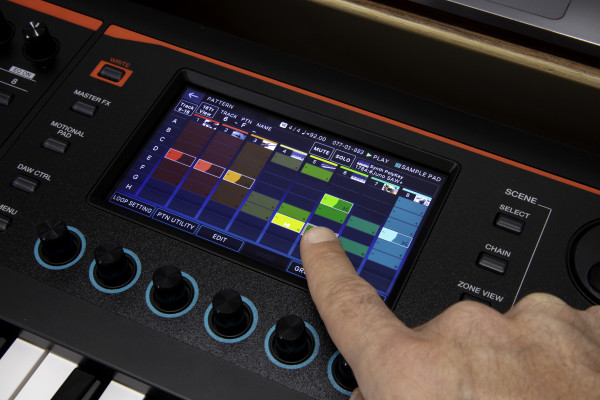
This certainly can be a tricky question to ask, as every producer and artist is looking for something different from a keyboard like this.
If you haven’t gotten the point already, let me be obvious that this keyboard and the whole line of Fantom-0 keyboards, are not for the faint of heart. They all come with complex sound engines, model expansions, an intricate user interface, thousands of multitimbral soft synths to manipulate, and more. And all these features are tucked away behind sophisticated routing, menus, modulation matrixes, and more.
TL;DR – There is a bit of a learning curve to this tool…
But once you can get comfortable, or even master, the workflow of the power in the Fantom workstation, you will have everything in your hands to create and even perform professional music all in one place.
The Roland FANTOM-0 synthesizer keyboard series are available in the U.S. as of April April for the following prices:
FANTOM-06: $1,499.99
FANTOM-07: $1,799.99
FANTOM-08: $1,999.99

Will Vance is a professional music producer who has been involved in the industry for the better part of a decade and has been the managing editor at Magnetic Magazine since mid-2022. In that time period, he has published thousands of articles on music production, industry think pieces and educational articles about the music industry. Over the last decade as a professional music producer, Will Vance has also ran multiple successful and highly respected record labels in the industry, including Where The Heart Is Records as well as having launched a new label with a focus on community through Magnetic Magazine. When not running these labels or producing his own music, Vance is likely writing for other top industry sites like Waves or the Hyperbits Masterclass or working on his upcoming book on mindfulness in music production. On the rare chance he's not thinking about music production, he's probably running a game of Dungeons and Dragons with his friends which he has been the dungeon master for for many years.









![Baby Audio HyperWarp Review: Why Less [Processing] Is More](https://magneticmag.com/wp-content/uploads/2026/10/Untitled-Design-88-1024x683.png)